_edi.png)
Sales teams often deal with messy handoffs, fragmented data, and goals that don’t quite line up. That’s where operations teams come in. But which one do you actually need? Revenue Operations (RevOps) and Sales Operations (Sales Ops) may sound alike, but they play very different roles. Sales Ops focuses on improving sales team efficiency, while RevOps takes a broader view, aligning sales, marketing, and customer success.
The impact is hard to ignore. Gartner predicted that 75% of the fastest-growing companies would adopt a RevOps model by 2026, a mark many high-growth B2B organizations are already meeting or surpassing. McKinsey reports that top-quartile B2B companies achieve 2.6x greater gross margin per sales dollar than those in the bottom quartile, with operational alignment often driving that difference.
Still, the distinction between the two is often blurred. In this guide, we’ll break down how revenue operations and sales operations differ, why it matters, and how the right choice can unlock stronger, more predictable growth.
Key Takeaways
- RevOps aligns sales, marketing, and customer success to drive total revenue, while SalesOps focuses on improving sales execution and pipeline efficiency.
- The difference shows up in ownership. RevOps owns revenue outcomes, SalesOps owns sales performance.
- RevOps tracks metrics like ARR, NRR, and forecast accuracy. SalesOps tracks close rates, deal velocity, quota attainment, and pipeline health.
- SalesOps helps address execution issues, including poor CRM usage, weak pipelines, and inconsistent rep performance. RevOps addresses misalignment, data fragmentation, and unpredictable growth.
- Teams that combine both functions use shared metrics and data to build a scalable and predictable revenue engine.
What is Revenue Operations (RevOps)?
Revenue Operations (RevOps) is the strategic alignment of sales, marketing, and customer success to drive predictable revenue growth. Instead of working in silos, these teams share data, insights, and processes to create a seamless customer journey. RevOps focuses on improving efficiency, reducing friction, and ensuring every revenue-generating function works together toward the same goals. It's not just about closing deals; it's about optimizing the entire revenue engine, from lead generation to customer retention.
Key Functions of RevOps
RevOps plays a crucial role in streamlining operations and improving revenue efficiency. Here are its main functions:
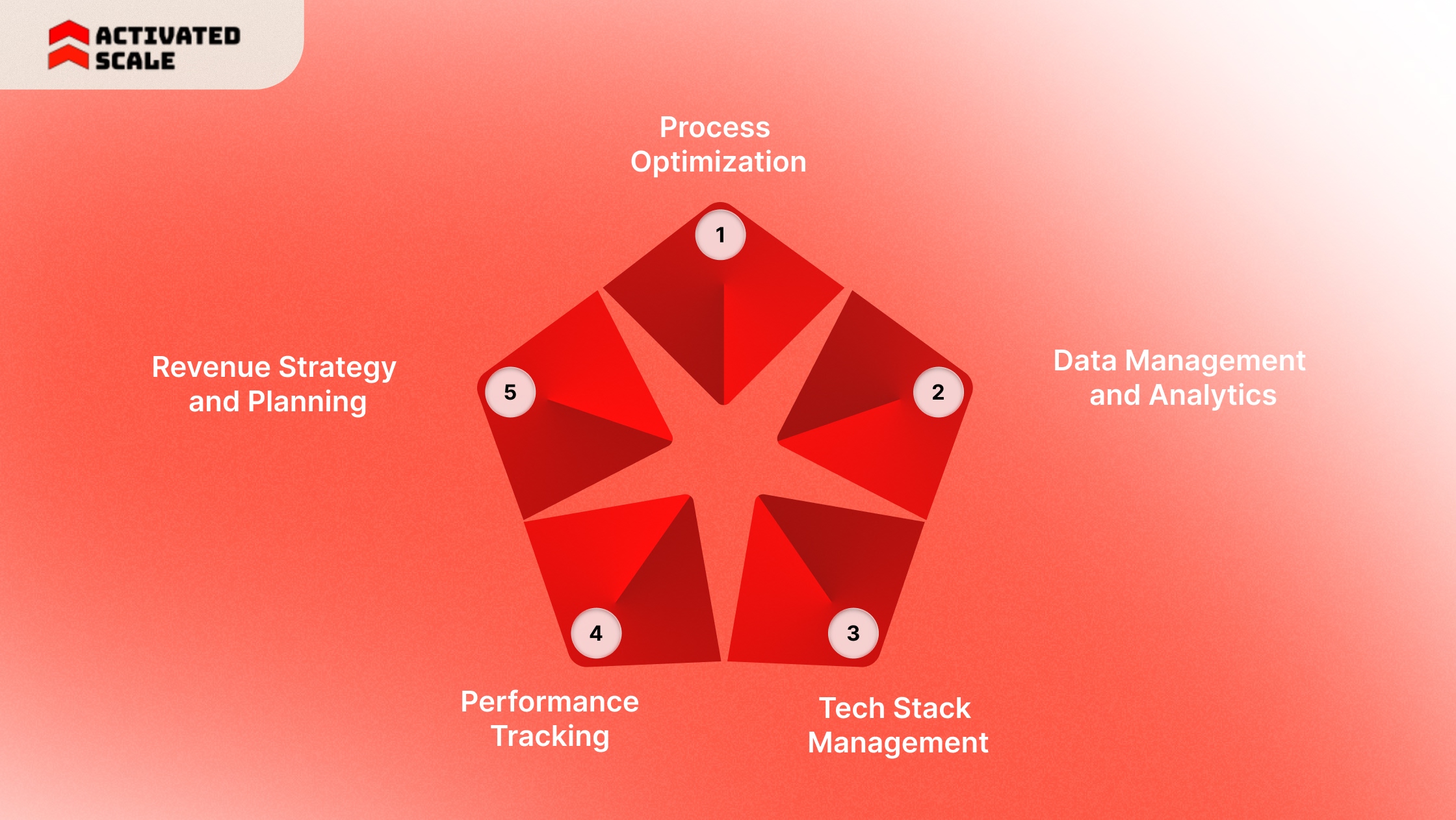
• Process Optimization: Standardizing workflows to ensure smoother collaboration between sales, marketing, and customer success.
• Data Management and Analytics: Gathering and analyzing customer data to make informed decisions and improve forecasting accuracy.
• Tech Stack Management: Integrating and maintaining CRM, automation tools, and analytics platforms for seamless operations.
• Performance Tracking: Monitoring key revenue metrics to identify bottlenecks and growth opportunities.
• Revenue Strategy and Planning: Aligning cross-functional teams to create long-term revenue strategies.
Benefits of RevOps
When implemented correctly, RevOps can transform how businesses operate. Here's how:
• Increased Revenue Predictability: With better data insights, businesses can forecast revenue more accurately.
• Improved Collaboration: Sales, marketing, and customer success teams work in sync, reducing misalignment.
• Higher Efficiency and Productivity: Automation and standardized processes eliminate inefficiencies.
• Better Customer Experience: A streamlined journey ensures customers receive consistent and personalized interactions.
• Scalability: RevOps creates a solid foundation for growth without operational bottlenecks.
By breaking down silos and aligning teams around a unified strategy, RevOps helps businesses drive sustainable, scalable revenue growth. Now let's talk about SalesOps.
Suggested Read: Who Should Revenue Operations Report To and Why?
What is Sales Operations (SalesOps)?
Sales Operations (SalesOps) is the backbone of a high-performing sales team. It focuses on streamlining processes, optimizing tools, and providing data-driven insights to help sales reps close deals faster. Instead of chasing administrative tasks, sales teams can focus on selling while SalesOps handles forecasting, CRM management, and strategy. Think of it as the engine that keeps the sales machine running smoothly, ensuring efficiency, scalability, and revenue growth.
Key Functions of SalesOps
SalesOps is all about making the sales process more efficient and effective. Here's what it typically involves:
• Sales Strategy and Planning: Developing sales processes, territory mapping, and quota setting to maximize performance.
• CRM and Technology Management: Managing sales tools and automation software to keep data accurate and accessible.
• Performance Analytics and Reporting: Tracking KPIs like conversion rates and sales cycle length to identify areas for improvement.
• Sales Enablement: Providing reps with training, resources, and playbooks to improve their success rates.
• Lead and Pipeline Management: Ensuring a steady flow of qualified leads and optimizing deal progression through the pipeline.
Benefits of SalesOps
A well-structured SalesOps team can transform sales performance in multiple ways:
• Boosts Sales Productivity: Eliminates time-consuming admin work, allowing reps to focus on selling.
• Enhances Data-Driven Decision Making: Provides actionable insights to improve sales strategies.
• Improves Forecasting Accuracy: Helps businesses predict revenue and adjust strategies accordingly.
• Optimizes Sales Processes: Reduces friction and streamlines workflows for better efficiency.
• Supports Scalability: Lays the groundwork for sustainable growth as sales teams expand.
By fine-tuning sales processes and empowering reps with the right tools and data, SalesOps ensures every deal has the best chance of closing. In the next part, we will discuss the key differences between revenue operations and sales operations!
Suggested Read: Revenue Growth Case Interview: Strategy and Framework
Revenue Operations vs Sales Operations: Key Differences
Revenue Operations (RevOps) and Sales Operations (SalesOps) are often confused, but they serve distinct roles in a business. While both focus on improving efficiency and revenue growth, their scope, responsibilities, and impact differ.
SalesOps zeroes in on optimizing sales teams, while RevOps takes a company-wide approach, aligning sales, marketing, and customer success. Understanding these differences can help businesses choose the right strategy to maximize growth and efficiency.
Here is a detailed comparison of revenue operations vs sales operations:
While SalesOps is essential for improving sales efficiency, RevOps takes a more comprehensive approach to revenue growth. Ultimately, the right approach depends on your company's goals and growth stage.
However, understanding these differences is only the first step. In practice, the real distinction becomes clear when you look at how each function measures success. RevOps and SalesOps operate on different sets of metrics, and those metrics directly shape how teams prioritize work, evaluate performance, and make decisions.
Key Metrics: RevOps vs SalesOps
Each function tracks a different set of KPIs, reflecting its role in driving revenue versus improving sales performance. Let’s look at the KPIs each team tracks:
How to Use These Metrics Together
The most effective revenue organizations don't silo these metrics; they use them in combination. For example, if your SalesOps team sees deal velocity slowing, your RevOps team can analyze whether the issue lies in lead quality (marketing), the sales process (SalesOps), or post-sale churn (customer success). Tracking both sets of KPIs in a shared dashboard is one of the highest-leverage moves a scaling B2B company can make.
When to Implement Sales Operations?
If your sales team is spending more time on admin work than selling, deals are slipping through the cracks, or forecasting feels like guesswork, it might be time to implement Sales Operations (SalesOps). A well-structured SalesOps function removes inefficiencies, optimizes processes, and empowers sales teams to focus on closing deals. But when exactly should a business invest in SalesOps?

Here are some key signs:
1. Your Sales Team is Growing Rapidly
As a startup or small business, manual processes might work initially. But as you scale, managing a growing sales team without a structured system becomes chaotic. SalesOps ensures smooth onboarding, standardizes processes, and keeps data organized.
Example: A tech startup with five sales reps might get by without SalesOps, but when they scale to 20 reps, tracking deals manually becomes a nightmare.
2. Inconsistent Sales Performance Across Reps
If some reps are crushing quotas while others struggle, it could indicate a lack of standardized processes. SalesOps establishes clear sales playbooks, training programs, and best practices to create consistency.
Example: One rep might be closing deals in half the time of others because they use a specific follow-up technique. SalesOps can identify and implement this best practice across the team.
3. Your CRM is a Mess
A disorganized Customer Relationship Management (CRM) system leads to lost leads, duplicated efforts, and inaccurate reporting. SalesOps manages CRM hygiene, ensuring accurate data and automation to streamline workflows.
Example: If your sales reps spend more time updating CRM fields than talking to customers, SalesOps can introduce automation to reduce manual work.
4. Forecasting is Unreliable
If revenue predictions are constantly off, it’s a sign that your data tracking and analysis need improvement. SalesOps introduces data-driven forecasting by analyzing sales trends, conversion rates, and pipeline health.
Example: A company might predict $1M in revenue for the quarter but end up with $700K because their forecasting lacked real-time data insights.
5. Lead Management is Unstructured
Are leads slipping through the cracks? Are your reps chasing unqualified prospects? SalesOps helps implement lead scoring systems and ensures a structured pipeline for prioritizing high-value opportunities.
Example: Without lead scoring, a sales rep might waste time on a cold lead instead of focusing on a hot prospect ready to buy.
When to Implement Revenue Operations?
If your sales, marketing, and customer success teams feel like they’re speaking different languages, your revenue growth might be hitting a ceiling. Revenue Operations (RevOps) ensures that all revenue-generating teams are aligned, data-driven, and working toward the same goals. But when is the right time to introduce RevOps?
Here are key signs that your business needs it:
1. Sales, Marketing, and Customer Success Are Misaligned
If your marketing team brings in leads that sales ignores, or customer success struggles with unclear handoffs, you need RevOps to unify these teams. Misalignment leads to lost revenue opportunities.
Example: Marketing reports an increase in qualified leads, but sales says conversion rates are dropping. RevOps can bridge the gap with shared data and better processes.
2. Your Business is Scaling Quickly
Growth is great, but without proper revenue processes, it can turn chaotic. RevOps ensures smooth scaling by standardizing workflows, optimizing the tech stack, and improving forecasting.
Example: A SaaS company doubling its customer base in a year needs RevOps to manage increasing complexity and keep revenue predictable.
3. Data is Scattered Across Multiple Tools
If you have separate systems for sales, marketing, and customer data that don’t communicate well, RevOps can integrate these tools to create a single source of truth.
Example: Marketing uses HubSpot, sales uses Salesforce, and customer success relies on another CRM; RevOps syncs them to ensure seamless data flow.
4. Revenue Forecasting is Inaccurate
Unreliable revenue projections signal a need for better analytics and cross-functional visibility. RevOps centralizes data to improve forecasting and decision-making.
Example: If your projected revenue is off by 30% every quarter, RevOps can refine forecasting models using real-time insights.
5. Customer Churn is High
If customers leave soon after signing up, it’s often a sign of broken post-sale processes. RevOps ensures smooth onboarding and retention strategies, boosting customer lifetime value.
Example: A subscription business sees high churn due to poor onboarding. RevOps can align customer success with sales for better handoffs and proactive support.
Suggested Read: How to Calculate and Improve Sales Velocity for Maximum Revenue Impact
How to Effectively Combine RevOps and SalesOps?
Revenue Operations (RevOps) and Sales Operations (SalesOps) work best when they complement each other rather than operate in silos. To maximize efficiency and drive predictable growth, you need to create a seamless collaboration between the two.
Here’s how:
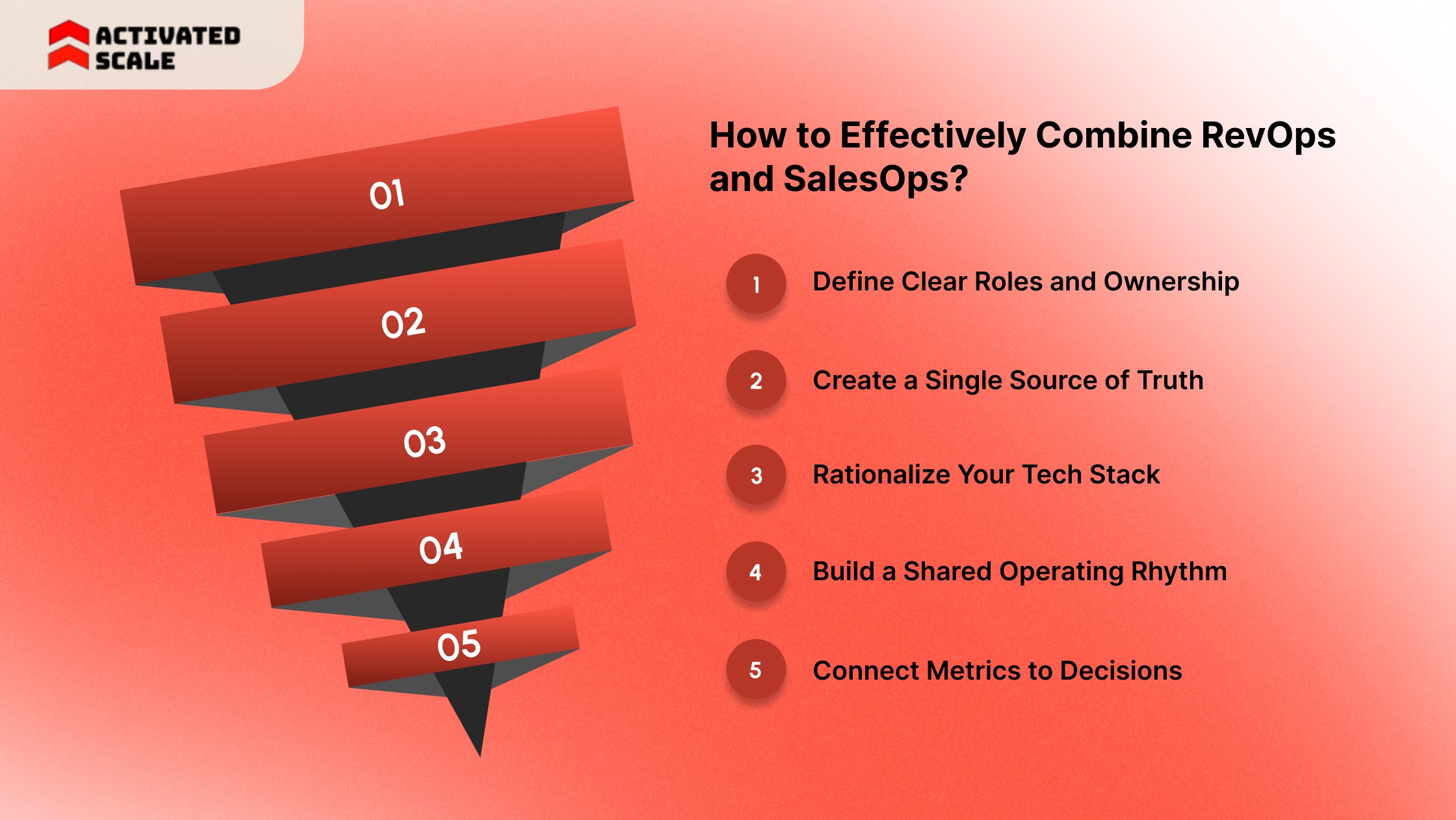
1. Define Clear Roles and Ownership
Start by mapping responsibilities across the revenue lifecycle. Avoid vague overlap.
- Assign SalesOps ownership to:
- Pipeline management.
- CRM configuration for sales.
- Territory and quota planning.
- Assign RevOps ownership to:
- Revenue forecasting across teams.
- Data governance.
- Cross-functional process design.
How to implement: Create a simple ownership matrix for every stage from lead to renewal. If two teams “own” the same responsibility, resolve it immediately.
2. Create a Single Source of Truth
Disconnected data breaks alignment. Both teams must work from the same definitions and dashboards.
What to standardize:
- Define what qualifies as a lead.
- Align pipeline stage definitions.
- Ensure consistent reporting logic across teams.
How to set it up: Sync systems to enable data to flow between tools like HubSpot and Salesforce, and build a shared dashboard for pipeline, conversion rates, and revenue.
Suggested Read: Pipeline Reporting for Startups: 5 Reports That Predict Revenue
3. Rationalize Your Tech Stack
Most teams don’t need more tools. They need better-connected ones.
Where to start:
- Audit all tools used by sales, marketing, and customer success.
- Identify overlap or duplicate functionality.
- Prioritize integration over expansion.
What to fix first: If data is being manually transferred between tools, that is the first point of failure to eliminate.
4. Build a Shared Operating Rhythm
Alignment needs to be maintained through consistent collaboration.
Cadence to follow:
- Weekly pipeline reviews led by SalesOps.
- Monthly revenue reviews led by RevOps.
- Shared dashboards are accessible across teams.
What to focus on: Pipeline health, stage-wise conversion rates, and drop-offs between handoffs.
5. Connect Metrics to Decisions
Metrics should directly inform actions, not just reporting.
What this looks like in practice:
- If win rates drop, SalesOps reviews deal execution and sales behavior.
- If pipeline quality declines, RevOps evaluates lead sources and targeting.
- If churn increases, RevOps works with customer success to fix onboarding and retention.
Tools like Clari and Gong can surface these insights, but clear ownership is what ensures follow-through.
When RevOps and SalesOps operate with shared data, defined ownership, and a consistent operating cadence, the result is a revenue engine that is predictable, scalable, and easier to optimize.
If you are looking to implement this without overloading your internal team, bringing in experienced operators can help you move faster and maintain execution quality. Activated Scale provides access to vetted SDRs, AEs, and sales leaders who can step into your workflows and start contributing immediately. You can book a demo to see how this fits into your current setup.
Suggested Read: A Chief Revenue Officer vs A VP of Sales: Which Leader Owns Growth?
Benefits of Combining RevOps and SalesOps
When Revenue Operations (RevOps) and Sales Operations (SalesOps) work together, you create a powerful system that drives efficiency, growth, and predictable revenue. Here's why combining them is a game-changer:
1. Stronger Alignment Across Teams: With RevOps overseeing the entire revenue process and SalesOps fine-tuning sales efficiency, there's better coordination between sales, marketing, and customer success. Everyone works toward the same revenue goals.
2. More Accurate Revenue Forecasting: Combining RevOps and SalesOps provides a complete view of the revenue pipeline, improving forecasting accuracy. Businesses can predict revenue trends and adjust strategies proactively.
3. Improved Efficiency and Productivity: With a unified approach, redundant processes are eliminated, workflows are optimized, and teams spend less time on administrative tasks.
4. Better Use of Data and Insights: When data is centralized and accessible across teams, businesses gain deeper insights into lead quality, sales performance, customer behavior, and revenue trends.
5. Enhanced Customer Experience: A seamless transition from marketing to sales to customer success ensures a consistent and personalized customer journey, leading to higher satisfaction and retention.
6. Optimized Tech Stack: A combined RevOps and SalesOps approach eliminates tool duplication and ensures seamless integration between CRM, automation, and analytics platforms.
7. Scalability for Long-Term Growth: With well-structured operations, businesses can scale faster without revenue bottlenecks. Standardized processes and data-driven insights make expansion smoother and more sustainable.
By integrating RevOps and SalesOps, you remove inefficiencies, improve collaboration, and create a more predictable revenue engine. The result is faster growth, happier customers, and a competitive edge in the market.
How AI is Changing RevOps and SalesOps in 2026?
Artificial intelligence is reshaping how both RevOps and SalesOps teams operate, not by replacing human judgment, but by handling the data-heavy tasks that previously consumed hours every week.
AI in Revenue Operations
• Revenue forecasting: AI models (built into tools like Salesforce Einstein and Clari) now analyze pipeline signals, deal history, and rep behavior to produce forecasts accurate to within 5–10%, compared to 20–30% error rates in manual forecasting.
• Data governance: AI flags duplicate records, incomplete fields, and data inconsistencies across connected tools in real time, dramatically reducing CRM hygiene overhead.
• GTM intelligence: Platforms nowadays use AI to enrich prospect data from dozens of sources simultaneously, giving RevOps teams a unified view of their total addressable market.
AI in Sales Operations
• Conversation intelligence: Tools like Gong analyze every sales call and email to surface winning patterns, which track close deals, where deals stall, and what top reps do differently.
• Lead prioritization: AI-driven lead scoring replaces manual qualification, routing the highest-intent prospects to reps automatically.
• Quota and territory modeling: AI helps SalesOps model dozens of quota allocation scenarios in minutes rather than days.
As targeting improves, the pressure on sales teams increases. Reps are expected to act faster, follow up more precisely, and convert better opportunities without adding headcount at the same pace. You can address this gap by bringing in experienced operators who can execute within these AI-driven workflows and maintain pipeline velocity.
Providers like Activated Scale give access to vetted SDRs, AEs, and sales leaders who can step into these environments and contribute immediately without long ramp times.
Conclusion
At the end of the day, the debate around revenue operations vs sales operations is all about understanding what your business actually needs right now.
If your challenge is execution, pipeline movement, or rep performance, SalesOps brings the structure. If the problem runs deeper across teams, data, and forecasting, RevOps creates the alignment needed to scale. The real advantage comes when both functions work together, using shared metrics to drive clearer decisions and more predictable revenue.
That is also where most growing U.S teams get stuck. You know what needs to be fixed, but hiring, structuring, and executing slow everything down.
Activated Scale helps you move faster by giving you access to:
- Fractional SDRs and AEs to build and convert the pipeline.
- Experienced sales leaders to design GTM strategy and processes.
- Contract-to-hire talent so you can validate before committing.
Instead of spending months building from scratch, you can plug in proven operators who already understand how to drive outcomes across RevOps and SalesOps.
If you are ready to turn strategy into execution, book a demo with Activated Scale and see how you can scale your revenue engine without slowing down.
FAQs
1. Is operating revenue the same as sales?
No. Operating revenue includes all core business income from sales and services. Sales revenue tracks only product and service transactions. RevOps optimizes total operating revenue across teams.
2. What falls under revenue operations?
Revenue Operations includes sales, marketing, and customer success alignment. It covers process optimization, tech stack integration, data analytics, forecasting, and cross-team execution of revenue strategies.
3. How do I calculate operating revenue?
Operating revenue equals total core business revenue from products and services, excluding non-operating income, such as investments. Review your P&L statement and subtract investment income from total revenue.
4. What is the difference between RevOps and SalesOps roles?
RevOps aligns all revenue teams company-wide for predictable growth. SalesOps focuses specifically on sales team execution, pipeline management, and rep productivity optimization within the sales function only.
5. Can SalesOps report into RevOps?
Yes. SalesOps commonly reports into RevOps in mature organizations. RevOps provides strategic oversight while SalesOps handles tactical sales execution with shared revenue metrics and dashboards.
6. How does RevOps impact sales quota attainment?
RevOps boosts quota attainment by improving lead quality, enabling accurate forecasting, and strengthening pipelines. SalesOps data typically shows a 15-20% improvement in quota attainment from strong RevOps alignment.
The Ultimate Guide to Hiring a Salesperson!
Get the step-by-step guide to hiring, onboarding, and ensuring success!